
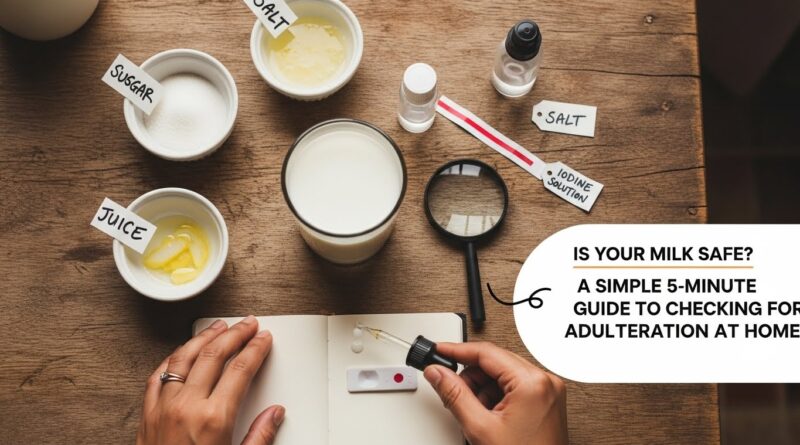
Is Your Milk Safe? A Simple 5-Minute Guide to Checking for Adulteration at Home
Is Your Milk Safe? A Simple 5-Minute Guide to Checking for Adulteration at Home
Milk adulteration is a serious threat, but you don’t need a lab to check for common contaminants.
India is the world’s largest producer and consumer of milk, yet studies often show that a significant portion of the milk supply is adulterated with contaminants ranging from simple water to dangerous chemicals like detergent and urea. This widespread problem, often driven by the desire to increase volume or shelf life, poses a major risk to public health, especially for children and the elderly.
The good news is that the Food Safety and Standards Authority of India (FSSAI) has empowered consumers with simple methods to check for purity using common kitchen items. This is part of the DART (Detect Adulteration with Rapid Test) initiative.
Here are the step-by-step home tests for common adulterants found in milk and ghee.
🔬 Test 1: Checking for Added Water (The Slanting Surface Test)
Water is the most common adulterant, added to increase volume. While it sounds harmless, it reduces the nutritional value and introduces a risk of bacterial contamination if the water source is unclean.
- Preparation: Place a drop of milk on a polished, slanting surface (like a marble slab, a glass slide, or the back of a stainless-steel plate).
- Observation:
- Pure Milk: The milk drop will move slowly down the surface, leaving a distinct, thick white trail behind it.
- Adulterated Milk (with water): The drop will flow down rapidly without leaving a white trail.
🧼 Test 2: Checking for Detergent (The Lather Test)
Detergent (soap powder) or soap flakes are added to milk to give it a thick, frothy appearance, masking the dilution caused by added water.
- Preparation: Take about 5 to 10 ml of the milk sample in a transparent glass bottle or a test tube.
- Procedure: Shake the bottle vigorously for about 30 to 60 seconds.
- Observation:
- Pure Milk: A thin layer of foam or lather will form on the surface, which disappears very quickly.
- Adulterated Milk (with detergent): A thick, persistent layer of foam or lather will form, similar to what you see when washing clothes. This lather will last for a long time.
🍚 Test 3: Checking for Starch or Maida (The Iodine Test)
Starch, flour (Maida), or even sugar is sometimes added to milk to increase its solid content (and therefore, its density) after water has been added.
- Preparation: Take 3 ml of the milk sample in a clean glass.
- Procedure: Bring the milk to a boil, then let it cool to room temperature. Now, add 2 to 3 drops of tincture of iodine or an iodine solution (commonly available at pharmacies).
- Observation:
- Pure Milk: No change in colour, or a very slight brownish/yellowish colour from the iodine itself.
- Adulterated Milk (with starch): The colour of the milk will immediately change to deep blue. The intensity of the blue indicates the amount of starch present.
🧈 Test 4: Checking for Vanaspati in Ghee (The Hydrochloric Acid Test)
Ghee (clarified butter) is often adulterated with cheaper fats like vegetable oil or vanaspati (hydrogenated vegetable oil) to increase profit margins.
- Preparation: Take a teaspoon of the suspected ghee sample in a test tube or a small, clean glass container.
- Procedure: Add a pinch of powdered sugar and about 5 ml of concentrated hydrochloric acid (HCl) to the ghee.
- Observation:
- Pure Ghee: The mixture will remain largely colourless.
- Adulterated Ghee (with Vanaspati): A distinct crimson or red colour will immediately appear in the lower layer of the mixture.
🚨 You Tested Positive: What to Do Next?
If any of these tests indicate adulteration, it is important to take action:
- Do Not Consume: Avoid consuming the suspected batch of milk or ghee.
- Gather Details: Note down the brand, packaging date, batch number, and the location where you purchased the product.
- Report to FSSAI: You can easily report food safety concerns through the FSSAI’s Food Safety Connect portal or their dedicated mobile application. Your complaint will be forwarded to the relevant state food safety authorities for investigation and necessary action against the vendor or producer.
By using these simple DART techniques, you not only protect your family’s health but also become an active participant in FSSAI’s mission to ensure a safe and healthy food supply chain across India. Be vigilant, test often, and eat safe!