Decoding the Vegetarian/Non-Veg Symbols: The One Thing FSSAI Made Mandatory
That little green or brown symbol on your food package is more than just a decoration—it’s a crucial legal declaration protecting your dietary choices.
In a country as diverse as India, where religious and cultural beliefs heavily influence dietary habits, food labeling is not just about nutrition; it’s about trust and respect. The Green Dot and Brown Triangle symbols on packaged foods are arguably the most important safety features mandated by the FSSAI, guaranteeing that what you are about to eat aligns with your personal choices.
The Mandate: Why These Symbols are Non-Negotiable
The FSSAI’s Food Safety and Standards (Packaging and Labelling) Regulations, 2011, clearly state that every packaged food item must prominently display a non-vegetarian or vegetarian symbol. This requirement is strictly enforced and is central to the regulator’s commitment to consumer rights.
The Vegetarian Symbol
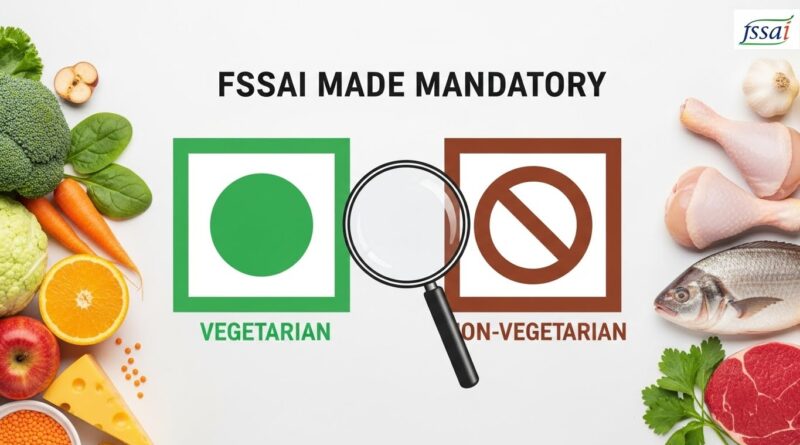
- Appearance: A small green filled circle inside a green square outline.
- Definition: As per FSSAI, any article of food that does not contain any whole or part of any animal, including birds, fresh water or marine animals, eggs, or any product of animal origin (other than milk, milk products, and honey).
The Non-Vegetarian Symbol
- Appearance: A small brown filled triangle inside a brown square outline.
- Definition: Any article of food that contains any whole or part of any animal, including fish, poultry, beef, or mutton, or any ingredient or additive derived from non-vegetarian sources.
The Zero Tolerance Rule: Sources of Non-Veg Ingredients
The most critical part of the FSSAI’s definition lies in the ingredients, including hidden ones:
- Direct Ingredients: Meat, fish, eggs, etc.
- Additives & Processing Aids: This is where the symbols are most crucial. Many food additives, emulsifiers, gelatin, or food colours can be derived from animal fats or tissues. If even a single ingredient or processing aid (even if present in residual amounts) is non-vegetarian, the product must carry the brown symbol.
- Cross-Contamination: Even if the final product is vegetarian, if there is a risk of cross-contamination during manufacturing, FBOs (Food Business Operators) must take preventive measures and often default to the safest, most transparent label.
Location and Prominence
The symbols must be placed near the name or brand name of the product and be clearly displayed on the principal display panel of the package. They must also contrast with the background colour to ensure high visibility.
The Penalties for Mislabeling
Mislabeling the symbols is considered a serious offence. If a company fails to disclose a non-vegetarian ingredient and uses the green symbol, it is a direct violation of the FSS Act.
- Violation: It falls under the category of misbranded food, leading to potential regulatory action, seizure of stock, and heavy penalties.
- Trust: More importantly, it destroys consumer trust, which, for a food brand, can be a penalty far greater than any fine.
These two small symbols hold immense power. They are a daily reminder that FSSAI’s regulations go beyond just nutritional safety, prioritizing the fundamental right of every consumer to know exactly what they are choosing to put on their plate.